From the upper level a of a warm, dry bus, I noticed this park during the heavy downpour today. A couple of people rushed through the park quickly, looking like they were on there way somewhere else and one woman walked her dog.


From the upper level a of a warm, dry bus, I noticed this park during the heavy downpour today. A couple of people rushed through the park quickly, looking like they were on there way somewhere else and one woman walked her dog.
What if we stop fighting what people want to do and let it happen:

This might be the most interesting article I’ve read in a long time. I found my self copying large chunks and nearly duplicating the entire article while trying to pull out its most significant points.
Essentially, the author claims that enforcing curfews and closing certain areas at night isn’t preventing any violence. “Assuming that space becomes unsafe at night…is a self-fulfilling prophecy.” Prohibiting access to one place at night doesn’t prevent any of the behavior that this rule intends, it just relocates it. We need to give people “venues to air their grievances and debate appropriate remedies.”

As per Jane Jacobs (who was actually referenced in this article), safety is created by “eyes upon the street”. If we let people use parks at night freely, we enable “diverse coordination”, a coming together of all kinds of people doing various things and creating safety in numbers. Case in point is Amsterdam, mentioned throughout the article, once for legalizing public sex in one of its parks under the assumption that visitors will behave responsibly, limiting activities to nighttime, staying away from playgrounds and throwing any trash away afterward.
What I love about this article is that it trusts people will rise to the occasion when treated with respect and given responsibility.

After the midterm crit, my group got together and had a long discussion about the feedback we received.
One very helpful suggestion that we are going to implement is to take a step back and ask, “Why parks?”, “What underlying need do they serve?”. We are going to the park together to ask park users why they come to the park and how they feel when they’re there. We’re also splitting up to ask others why they think parks exist, why they go (if they go), and what feelings they associate with going to the park.
We are hoping that these exercises will help us to think in a less-solutionist way so that we can back away from our very specific tech ideas and explore park needs more organically and from multiple facets.
My group met and shared our ideas for improving parks. There was a lot of interesting variation, but we all seemed to include smart devices that could be leveraged to improve visitors’ enjoyment of parks and to aid park cleanliness and the environment.
Our next step is that we’re each focusing on one of our ideas for the design crit. I am looking further into how playgrounds could be used to generate electricity and teach children about sustainability.
This CNN article that I referenced in a previous post features a free outdoor gym in Hull, northeast England that generates electricity from its users’ workouts.
The cost of this novel park was a whopping £76000, but a substantially cheaper version is in the works. It is estimated that the plans for a new park would cost approximately £24000.
While this is a substantial sum of money, it is less shocking when you realize how much a normal playground can cost.
Action Play & Leisure‘s playgrounds range from £3000 for a very small playground (pictured below) to £50000.

While Playground Design and Constructions states that a very small playground would start at £30000.
An added expense of some electricity-generating technology discussed in the CNN article would be connecting electricity-generating parks like these to the power grid. However, gyms and playgrounds like these can be used to power local lights and devices for less.
Playground equipment is already being used this way in some places today. A nonprofit organization called Empower Playgrounds provides electricity-generating merry-go-rounds to schools in Ghana.
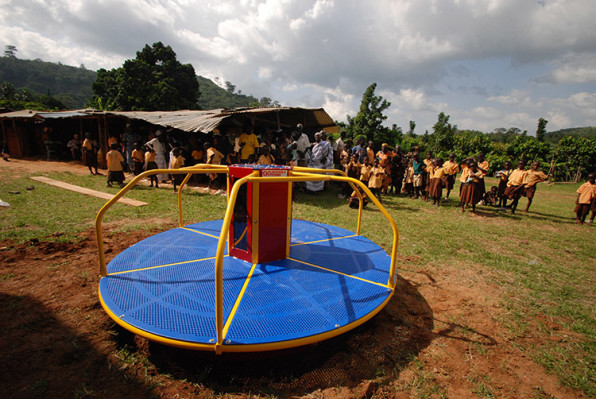
These merry-go-rounds are use to charge LED lanterns that students can take home at night. While their equipment costs £7600 to install, Empower Playground estimates that each merry-go-round can supply 200 children a year with electricity for at least 5 years – about £7.60 per student.
Another organization called Playground Energy is experimenting with the use of generators embedded in playground equipment. In the video below, they use the electricity generated to flash lights meant to encourage children to play more. Their mission is to promote health by getting kids exercising.
A non-financial benefit discussed in the CNN gym article is that outdoor electricity-generating gyms for adults raise awareness of sustainability. I think that this is an area for growth in electricity-generating playgrounds.
Rather than a new, state-of-the-art playground, one or two pieces of equipment or less-expensive adaptations to existing equipment could be effective educational tools. In my sketch below, the light meter above the equipment on the left shows the amount of energy needed before it will play a song – then this meter will reset. The larger meter on the right shows how much electricity has been generated that entire day compared to the high score for the week.


…to look for its strengths and to exploit and reinforce them. There is no logic that can be superimposed on the city; people make it, and it is to them, not buildings, that we must fit our plans.”
-Jane Jacobs
I think that this will be important to keep in mind while my team and I work on designing smart city solutions.
After meeting with my group and discussing our trips to the park, we came away with four ideas and pain points that we wanted to look into:
I am going to focus on composting, generating electricity, and digital signage that could aid animal-spotting and the issue of what time parks close. I am very interested in the idea of using the park at night, but I am still having trouble finding helpful resources and coming up with ideas.
Compost
My group discussed that dog-walking is common in parks and questioned what happened to the waste that the dogs left behind, noting that many parks were lacking in public trash bins.
This reminded me of free bag dispensers that I have seen in some parks and neighborhoods. The dispenser pictured below is full of biodegradable bags which could be composted along with their contents.


Another question my group asked was what happened to all of the leaves in the park after Autumn.
Whether they are currently raked and removed or left to crumble and decompose, leaves can be composted too. If it were combined with some fun games for kids or refreshments, a leaf-raking party might encourage the community to get together and help.
If you think this sounds suspiciously like Tom Sawyer having a blast painting that fence, you’re not entirely wrong. But remember how exciting it was when you were a kid to rake a giant pile and jump in it? I think there could be some potential here for local families to get together and have fun.
It’s a thing, look! -> (https://eastmorland.org/?p=468)

Public compost bins like these could be used for food, leaves, and dog waste. The compost could then be used to fertilize plants in the park or a community garden.

Generating Electricity
Outdoor gyms like this one could be used to generate electricity for park needs:

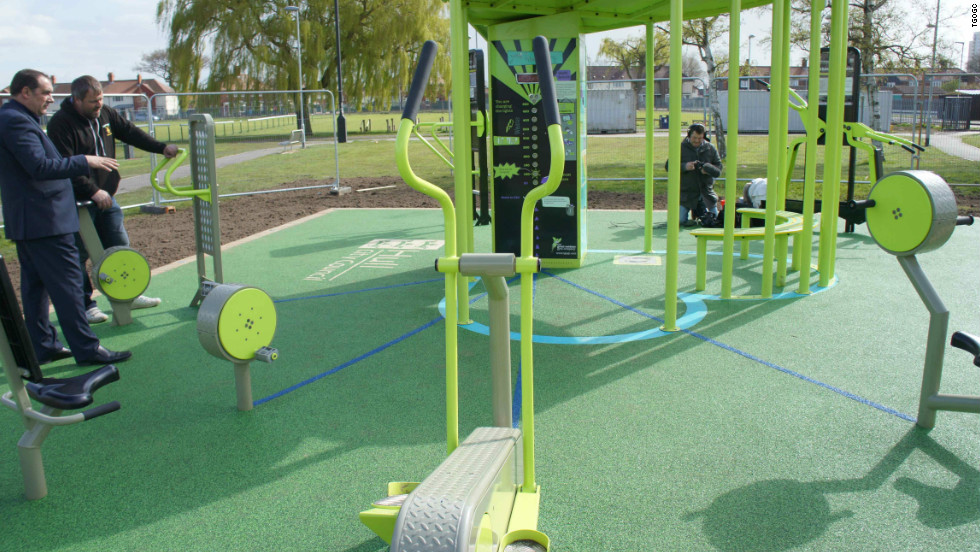
This article features an outdoor gym that’s already generating electricity:
https://edition.cnn.com/2012/11/27/world/europe/gym-workout-watts-electricity/index.html
But this doesn’t have to be limited to adult exercise. Playgrounds are a common park fixture. Swings or see-saws like those below could be adapted to generate electricity when used.

The electricity generated in the park could be used to power lights or digital signage:
Digital Signage
One of our group members mentioned a park where people often go hoping to see white deer. Unfortunately, however, it can be difficult to locate the deer in the park and they are disappointed.
An idea that we discussed was some way to track park animals so that visitors can see them. One obvious problem with this is that the animals need some reprieve from visitors. Perhaps the tracking would only work on part of the park or the animals would have a haven in a shelter, densely wooded area, or the water and islands (depending on the size of the park).
A screen like this in the park could be used to display the location of interesting park animals like pelicans (St. James’s park), deer, or black swans. Maybe it could even be powered by the gym equipment above.

Photo sources (map, pelican, swan)
One facet of my group’s concern about parks closing at night was that they often close at unpredictable times. Many parks close at “dusk”, but when exactly is that? Another digital sign could display:
“Park closes today at dusk 17:15”
Using the park at night
When my team was trying to figure out why parks closed at night, we thought that it might have to do with safety and trying to prevent people from sleeping inside the parks.
This made me wonder if there was a way to comfortably and safely allow people to sleep in the parks? With so many people sleeping on the streets (and probably in the parks already), could better lighting in some areas or more benches help? Is there a need or would there be any benefit from add some organization to who enters the park at night or when or where?
In our last meeting, my group shared our research on the topics we pulled from our brainstorming and discussed problems and possible solutions in each area. One topic that we all found interesting and decided to delve into more deeply was parks.
We decided to each go to a park and observe how people used the space and what issues or possible improvements we could see.
I sat down in St. James’s Park for a bit and took a walk around.

Some general things that I noticed:
Wildlife in parks
There are lots of birds and squirrels in St. James’s Park and the visitors at the park interacted with them in a few different ways while I was there.
I was wondering if (and how) there were really two pelicans on a rock in the water (not pictured). Then, I saw a sign was posted nearby to answer my question:

I also wondered how this cottage was being used and if anyone who worked in the park lived or stayed there to maintain the grounds and care for the animals.

Again, a helpful sign for visitors answered my questions:

This sign was posted near where I saw the pelicans:

Is it okay to feed the other birds?
I’ve been having sporadic issues with these photos. I think I’ve fixed the problem, but in case photos don’t load: https://photos.app.goo.gl/dh7xwnXXtvszqvsb8
The population density in cities often leads to increased debris and dirt and the perception that cities are dirty places. This is not always the case.


Litter
Pollution
Today, my group reconvened after each researching broad aspects of smart cities.
One idea that we talked about was noise pollution and using sound waves to generate electricity. I had no idea that this was possible, but amazingly, it is!

 Smart City Design Workbook


